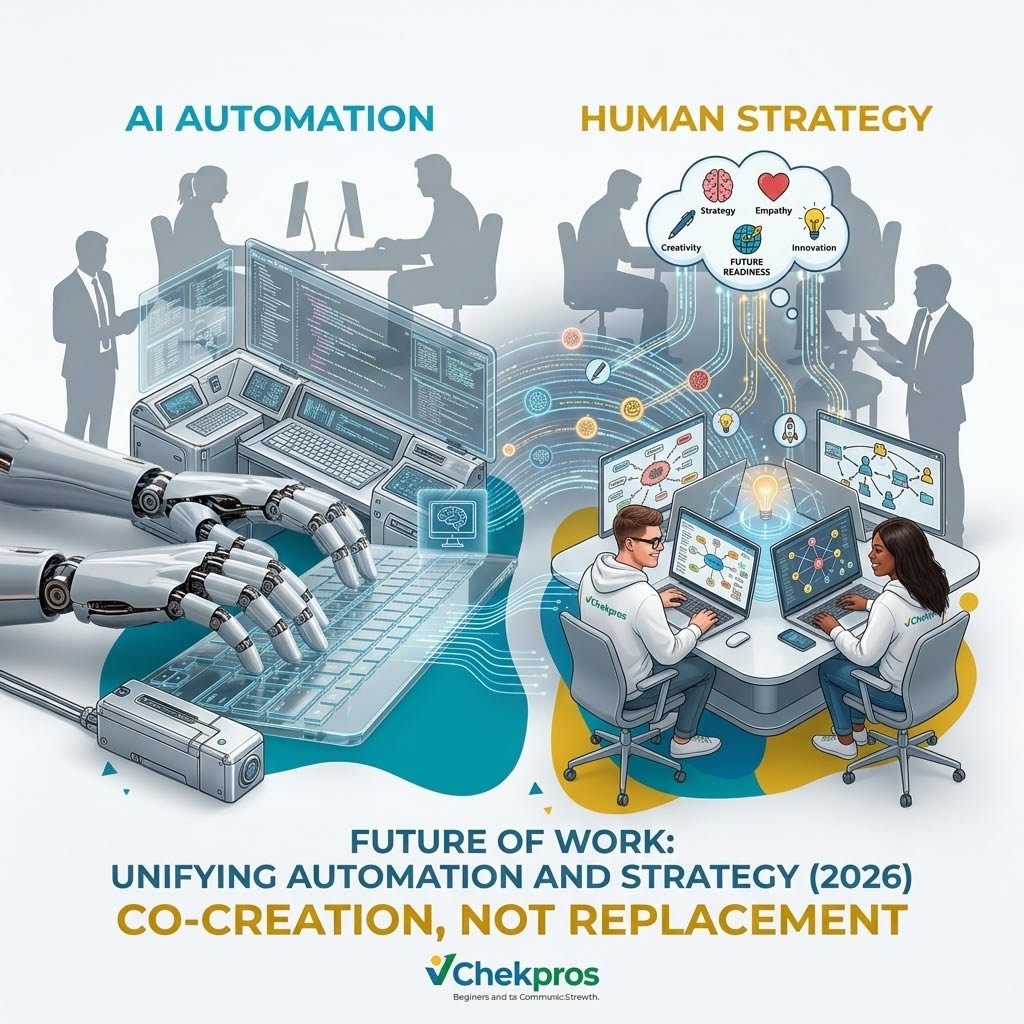
AI is changing how we work—but is it going to take your job? Discover which jobs are most likely to change, which skills are becoming more valuable, what new opportunities AI is creating, and how professionals can prepare for the future of work.
Artificial intelligence has moved from science fiction into the workplace.
AI can write.
AI can generate images and videos.
AI can analyze data.
AI can write software.
AI can summarize documents.
AI can translate languages.
AI can automate repetitive tasks.
AI can assist with research, marketing, customer service, design, finance, programming and countless other activities.
And that has created one of the biggest questions of our generation:
Will AI replace human workers?
The short answer is more complicated than a simple yes or no.
AI will replace some tasks.
It will change many jobs.
It will create new types of work.
And it will make some professionals dramatically more productive.
The biggest question is therefore not:
“Will AI replace humans?”
The better question is:
“Which humans will become more valuable because they know how to work with AI?”
That distinction could define the next decade of work.
AI Is Changing Work Faster Than Most People Realize
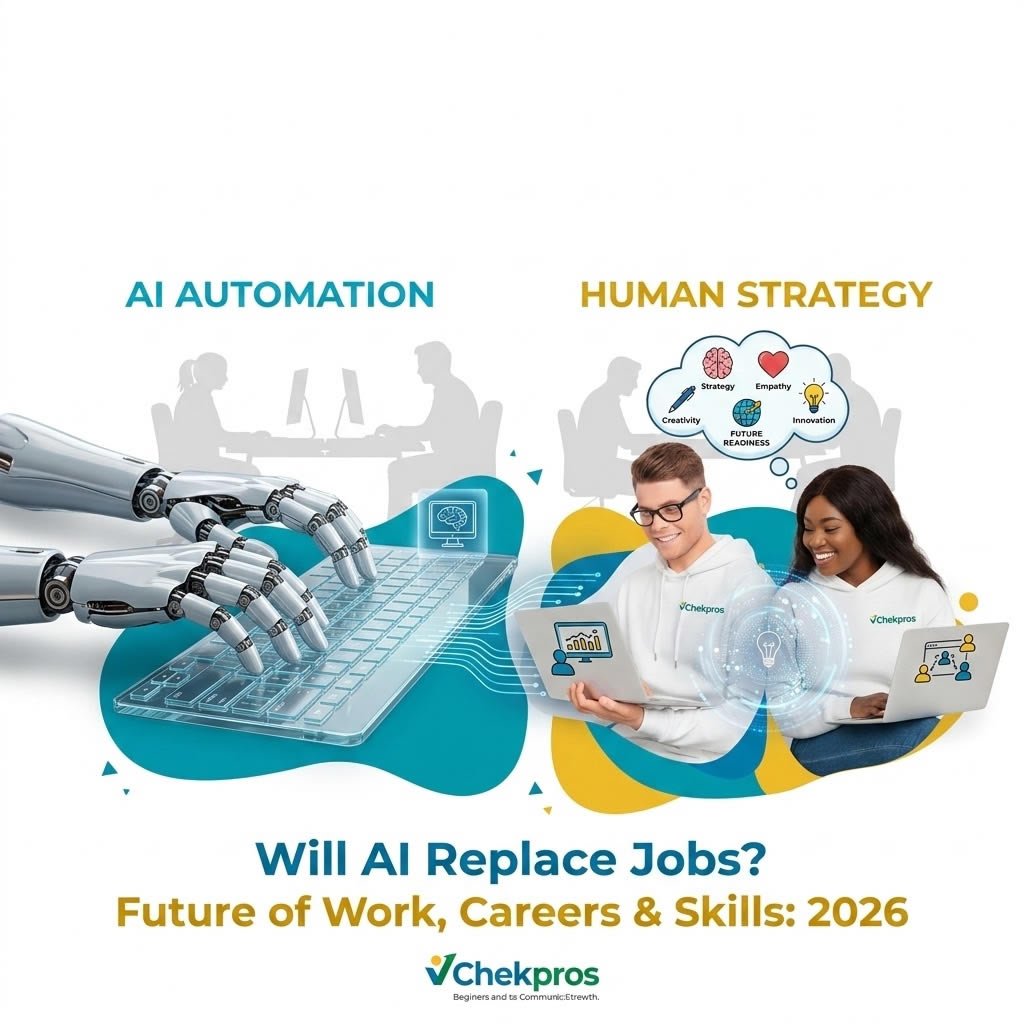
For years, automation primarily focused on physical or repetitive tasks.
Artificial intelligence is different.
Modern AI can increasingly participate in knowledge work.
It can help with writing, programming, research, analysis, design, customer support, marketing and decision-making.
McKinsey research has found that today’s technologies could theoretically automate tasks representing more than half of current U.S. work hours, although this is not a prediction that half of jobs will disappear. The organization emphasizes that work will evolve, with humans and intelligent machines increasingly working together.
This distinction between tasks and jobs is critical.
A job is usually a collection of many different tasks.
AI may automate five tasks inside a job without eliminating the entire occupation.
Instead, the professional may spend less time on repetitive work and more time on strategy, communication, creativity, decision-making and problem-solving.
That is where the future of work becomes interesting.
AI Will Change Jobs Before It Eliminates Them
Consider a marketing manager.
A marketing manager might previously have spent hours:
- Researching competitors
- Drafting content
- Creating campaign ideas
- Analyzing customer data
- Writing reports
- Preparing presentations
AI can now accelerate many of those activities.
But someone still needs to determine:
What should the company communicate?
Who is the target customer?
Which strategy makes commercial sense?
Which information is accurate?
Which campaign should be approved?
What should happen when the market changes?
AI can assist.
The human professional remains responsible for judgment.
This is why the future is unlikely to be as simple as humans versus machines.
It is increasingly becoming:
humans + AI.
The Rise of the AI-Enhanced Professional
A new category of professional is emerging.
They aren’t necessarily AI engineers.
They may be marketers, designers, developers, writers, consultants, analysts, project managers, accountants or entrepreneurs.
What makes them different is that they know how to integrate AI into their existing expertise.
A designer who understands AI can explore more concepts faster.
A developer who understands AI can accelerate development and testing.
A marketer can use AI for research, ideation and campaign analysis.
A writer can use AI to accelerate research and drafting while maintaining human editorial judgment.
A consultant can use AI to process information and spend more time on strategic recommendations.
The professional becomes more productive without surrendering responsibility for the final result.
Recent marketplace research shows this transition happening in practice. Upwork’s 2026 Future Workforce Index found that complex AI-augmented professional work is increasing in value, while lower-complexity AI execution work is becoming more commoditized.
The lesson is powerful:
Knowing how to use AI is becoming less impressive than knowing how to use AI to create valuable outcomes.
The Skills AI May Make More Valuable
If AI can perform more tasks, what should humans learn?
The answer is not simply “learn AI.”
Professionals should build a combination of technical skills and human capabilities.
1. Critical Thinking
AI can generate an answer.
You still need to determine whether the answer is correct.
Professionals who can question assumptions, identify errors, compare alternatives and make sound decisions will remain valuable.
2. Communication
Technology cannot eliminate the need to communicate with customers, colleagues, partners and stakeholders.
Clear communication remains one of the most transferable professional skills.
3. Creativity
AI can generate possibilities.
Humans still provide context, taste, direction and meaning.
Creative professionals who learn to use AI as a collaborator rather than simply fearing it may have an enormous advantage.
4. Problem-Solving
Companies don’t pay simply for activity.
They pay for problems to be solved.
The ability to understand a business problem and develop an effective solution will remain extremely valuable.
5. Adaptability
The tools available today may not be the tools professionals use three years from now.
The ability to learn continuously may become one of the most important career advantages.
6. Domain Expertise
This is increasingly important.
An AI tool may know a lot about accounting.
But an experienced accountant knows how financial information fits into an actual business.
An AI tool may generate marketing ideas.
But an experienced marketer understands customers, positioning and commercial objectives.
AI becomes more powerful when combined with deep domain knowledge.
Which Jobs Are Most Vulnerable to AI?
It is dangerous to create a simple list of “jobs AI will eliminate.”
The better approach is to examine the tasks inside those jobs.
Work that is highly repetitive, predictable, digital and rules-based is generally more exposed to automation.
Examples may include certain:
- Data processing tasks
- Basic administrative tasks
- Routine content production
- Repetitive customer support
- Basic document processing
- Simple information classification
- Routine reporting
But exposure does not automatically mean elimination.
Jobs can evolve.
A customer-service professional may move from answering basic questions to handling complex customer situations.
A writer may move from producing generic articles to developing content strategy and editorial direction.
A developer may spend less time writing routine code and more time designing systems.
The nature of the job changes.
AI Is Also Creating New Work
Every major technological transformation creates disruption.
But it can also create opportunities.
The AI economy is already producing demand for areas such as:
- AI integration
- AI automation
- AI development
- AI engineering
- AI video creation
- AI data annotation
- AI chatbot development
- AI workflow design
- AI consulting
- AI implementation
- AI governance
- AI quality assurance
Upwork’s 2026 marketplace data shows particularly strong growth in applied AI skills, including AI video generation and editing, AI integration, data annotation and chatbot development.
The World Economic Forum has likewise highlighted emerging human roles around AI oversight, including people responsible for designing how AI is used and evaluating its outputs.
This means the AI economy isn’t only about building artificial intelligence.
It is increasingly about applying AI to real-world problems.
The Most Valuable Professionals May Become “AI Orchestrators”
Imagine someone who understands:
- Business strategy
- AI tools
- Automation
- Data
- Communication
- Project management
- Quality control
- Industry-specific knowledge
They don’t simply ask an AI chatbot to produce something.
They design a workflow.
They decide which AI tools to use.
They give the system the right instructions.
They evaluate outputs.
They identify errors.
They bring humans into the process where judgment matters.
They measure the final business result.
This is the emerging AI orchestrator.
Upwork’s 2026 research describes this direction as professionals combining AI fluency with domain expertise, workflow design, judgment and business impact.
That may become one of the defining professional profiles of the AI economy.
What Freelancers Should Do Now
Freelancers are particularly exposed to technological change because their services are directly connected to market demand.
But that is also an advantage.
Freelancers can adapt quickly.
If you are a freelancer, consider the following strategy.
Don’t compete with AI on commodity tasks.
Instead, move toward:
Strategy + Expertise + AI + Execution.
For example:
Instead of:
“I write articles.”
Build toward:
“I develop SEO content strategies and use AI-assisted research and production to create high-quality content that supports organic growth.”
Instead of:
“I make videos.”
Build toward:
“I create AI-enhanced marketing videos designed for social media campaigns and customer acquisition.”
Instead of:
“I build websites.”
Build toward:
“I develop high-performance websites and AI-enabled digital experiences for growing businesses.”
The difference is positioning.
What Businesses Should Do
Businesses shouldn’t approach AI simply by asking:
“How many employees can we replace?”
A better question is:
“How can AI help our people produce better results?”
Organizations should identify:
- Repetitive tasks that can be automated.
- Processes where AI can increase productivity.
- Areas requiring human judgment.
- Skills the company will need in the future.
- New roles created by AI adoption.
- Training opportunities for existing employees.
- Specialized expertise that can be sourced externally.
This is where flexible talent marketplaces become increasingly important.
A company may need an AI specialist for one project.
It may need a cybersecurity expert for another.
It may need a designer, developer, marketer or consultant for a third.
The future workforce is likely to become increasingly flexible.
The Future Workforce Will Be More Human Than Many People Expect
There is an irony at the center of the AI revolution.
As machines become better at producing information, human judgment may become more valuable.
Why?
Because information is not the same thing as wisdom.
Generating an answer is not the same thing as making the right decision.
Producing content is not the same thing as understanding an audience.
Writing code is not the same thing as designing a successful product.
Creating an image is not the same thing as building a powerful brand.
The professionals who can connect AI output to real-world context will have an advantage.
What Should Students and Young Professionals Learn?
If you’re starting your career today, don’t build your entire future around one software tool.
Tools change.
Build durable capabilities.
Learn:
- AI literacy
- Communication
- Critical thinking
- Problem-solving
- Research
- Data literacy
- Creativity
- Business fundamentals
- Your chosen professional discipline
- Collaboration
- Adaptability
Then learn how AI can amplify those skills.
The objective isn’t to become dependent on AI.
It is to become more capable because AI exists.
Will AI Create More Opportunities for Freelancers?
Potentially, yes.
As companies adopt AI, they may require more specialized professionals to implement, integrate, monitor and improve AI-enabled workflows.
There is already evidence that AI-generated output can create additional human work rather than simply eliminating it. Recent Upwork research found that jobs involving human improvement of AI-generated work have grown substantially, including in software development and design.
This is an important development.
AI may create the first draft.
Humans improve it.
AI produces possibilities.
Humans select the best ones.
AI accelerates execution.
Humans provide judgment.
That collaboration could define the next generation of freelance work.
The Future of Work Isn’t About Humans vs. AI
The most important career decision you can make today isn’t choosing whether to fear AI or embrace it.
It is deciding how you will work alongside it.
The professionals who continuously learn, develop expertise, understand technology and remain focused on delivering real value will be positioned to adapt as the market changes.
And businesses that learn how to combine human expertise with AI-enabled productivity may gain a significant competitive advantage.
The future belongs neither exclusively to humans nor exclusively to machines.
It belongs to people who know how to use intelligent technology responsibly and effectively.
Your Next Opportunity Could Be Powered by Your Skills
The global workforce is becoming increasingly connected.
Companies can access specialized professionals beyond their immediate geographic location.
Professionals can build careers around their expertise and reach clients beyond traditional employment boundaries.
That is the opportunity behind platforms like Chekpros.
Whether you are a developer, designer, writer, marketer, consultant, accountant, virtual assistant, project manager, AI specialist or another professional, the future of work is increasingly about what you can accomplish.
Your skills are your advantage.
AI can become your multiplier.
The global marketplace can become your opportunity.
Ready for the Future of Work?
Explore opportunities, showcase your expertise and connect with businesses looking for skilled professionals on Chekpros.
The future isn’t waiting. Build your skills. Embrace AI. Find your next opportunity.
SEO Strategy
Primary Keyword: AI and future of work
Secondary Keywords:
- will AI replace jobs
- will AI take my job
- future of work 2026
- AI jobs 2026
- future of jobs
- AI and employment
- AI and freelancing
- AI skills
- jobs created by AI
- jobs AI cannot replace
- most valuable skills in AI era
- future careers
- AI career opportunities
- AI workforce
- human skills in AI era
- future of remote work
SEO Title:
Will AI Replace Jobs? The Future of Work & Careers in 2026
Meta Description:
Will AI replace your job? Discover how artificial intelligence is changing careers, freelancing, hiring and the skills professionals need to succeed in the future of work.
Suggested URL Slug:will-ai-replace-jobs-future-of-work
Featured Image Text:
WILL AI REPLACE YOUR JOB?
The Future of Work in 2026
Leave your comment